In a world dominated by sensory overload, digital distractions, and chaotic urban landscapes, finding true mental clarity has become a modern luxury. While neuroscience points to mindfulness apps and sensory deprivation tanks, an ancient architectural marvel nestled deep within the Himalayas has quietly mastered the science of cognitive peace for centuries: the Bhutanese Dzong.
A dzong is a distinct type of fortress-monastery architecture found mainly in Bhutan. Historically serving as military bastions, administrative hubs, and Buddhist monasteries, these massive stone structures command the valleys they overlook.
Beyond their geopolitical and spiritual roles, dzongs are masterclasses in neuro-architecture—the study of how the built environment impacts our brains, behavior, and mental health. Through a concept known as spatial sovereignty, the deliberate structural layout of a dzong creates an intentional cognitive pathway, systematically stripping away external noise to induce deep psychological stillness and mental clarity.
1. The Threshold Economy: Filtering Out the Mundane
Mental clarity rarely occurs instantly; it requires a transitional phase. Bhutanese dzongs are strategically engineered around an extensive, multi-layered entry system that forces a mental reset before you even set foot in the main compound.
Geographic Isolation: Dzongs are positioned on strategic landforms—at the confluence of rivers, atop steep ridges, or cutting across deep valley passes. Approaching a dzong requires physical effort, forcing a grounding connection with the immediate environment.
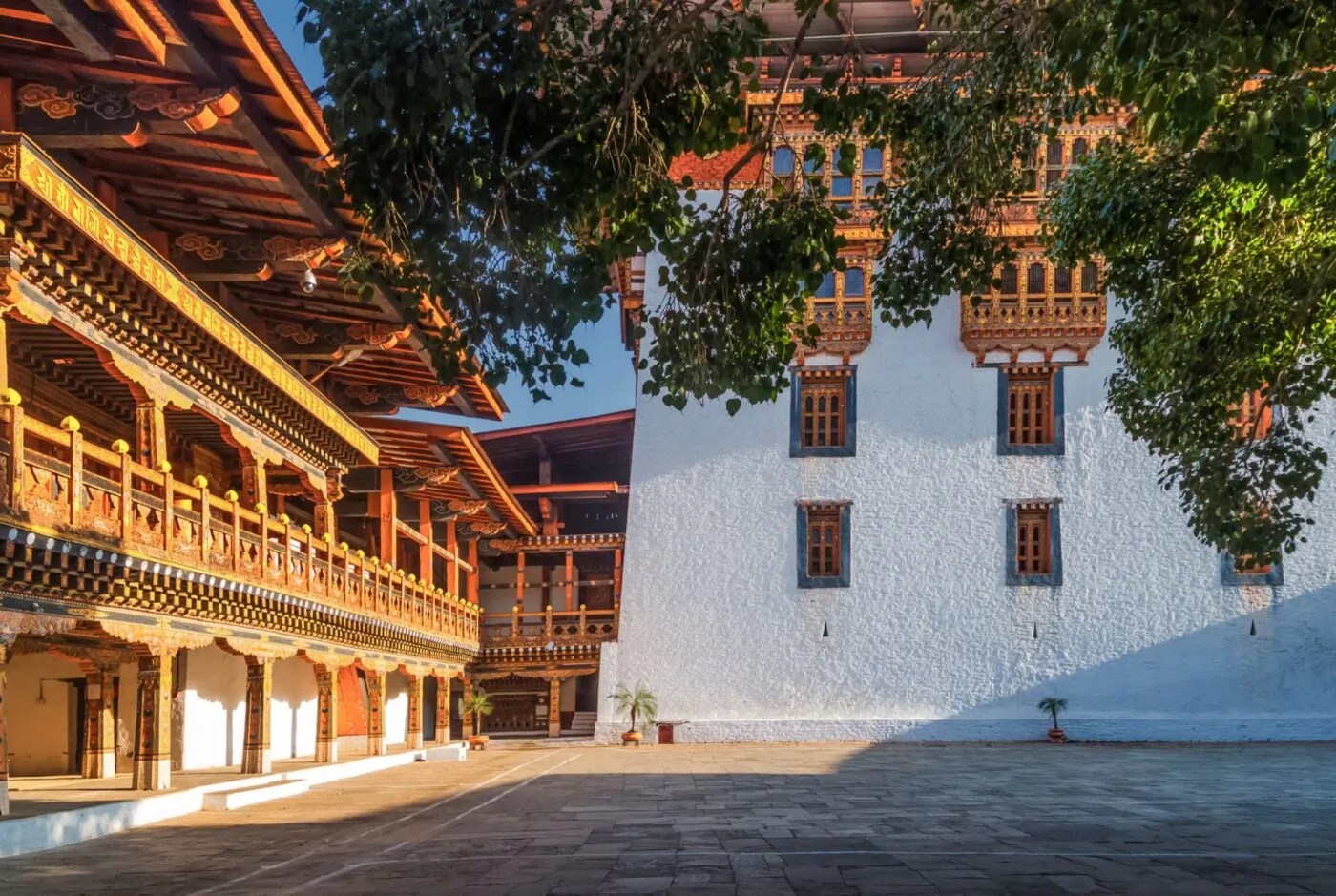
The Doche (Courtyard) Transition: Entrance is gained through heavy wooden doors and narrow, defensive entryways, which immediately open into vast, stone-paved courtyards (doche).
This sudden shift from a restricted, steep climb to an expansive, open courtyard triggers a psychological release. The brain registers a transition away from the vulnerabilities of the outside world into a protected, sovereign domain, causing immediate down-regulation of the nervous system’s fight-or-flight response.
2. Geometry and Proportions: Visual Order as Cognitive Balm
Once inside the courtyard, the visual language of the dzong speaks directly to the brain’s craving for symmetry and predictability.
Dzongs are built without formal blueprints. Instead, they are constructed under the direction of a high lama who orchestrates the proportions based on cosmic geometry and spiritual vision. The resulting aesthetics offer profound neurological benefits:
Massive, Inward-Sloping Stone Walls
The lower halves of a dzong feature colossal, whitewashed stone walls that gently slope inward. These blank expanses act as visual “white noise.” They eliminate the complex textures and visual clutter typical of modern cityscapes, giving the eyes a calm, neutral canvas to rest upon.
The Rhythmic Rabsel (Intricate Woodwork)
Contrasting sharply with the stark stone bases are the upper levels, adorned with highly ornate, hand-carved wooden windows and galleries (rabsel). Painted in rich, natural pigments of dark red, gold, and blue, these windows follow strict geometric intervals. Neuroscientists note that repeating patterns and rhythmic symmetry in architecture ease cognitive fatigue, lowering the mental processing power required to interpret your surroundings.
3. The Dualism of Layout: Separating the Secular from the Sacred
A core structural characteristic of the dzong is its division into two distinct, functional halves divided by a massive central tower known as the Utse. This spatial binary effectively segregates human concerns, cultivating an internal mental shift as you navigate the complex.
| Architectural Zone | Functional Use | Psychological State Induced |
| Secular Half | Administrative offices, regional courts, political governance. | Active engagement, logical processing, societal connection. |
| The Utse (Center) | Towering sanctuary containing sacred shrines and relics. | Spiritual anchor, transition point, centering of attention. |
| Sacred Half | Monastic quarters, meditation halls, prayer courtyards. | Contemplation, introspection, complete quietude. |
By walking past the central Utse into the monastic sector, you physically move away from social roles, bureaucracy, and daily chatter. This physical partitioning mirrors a necessary psychological process: to achieve mental clarity, one must consciously separate administrative worries from reflective mental space.
4. Acoustic Sanctuary and the Micro-Climate effect
Modern environments are plagued by low-frequency acoustic noise—traffic, machinery, and ambient static—which elevates cortisol levels and fragments focus. The structural density of a dzong creates an absolute acoustic sanctuary.
The outer walls of a dzong can be up to three meters thick at the base, constructed from packed earth and river stone. These massive barriers absorb external sound completely.
Within the courtyards, the only acoustics are natural: the wind rustling through nearby prayer flags, the distant rushing of rivers below, or the rhythmic, low-frequency chanting of monks.
According to psychoacoustic research, natural, low-amplitude sounds act as “attention restoration triggers,” allowing the prefrontal cortex to recover from multi-tasking fatigue and restore focused, linear thinking.
Conclusion: Designing for the Mind
The Bhutanese dzong is far more than a historical relic or a striking tourist attraction; it is a profound testament to the power of conscious architecture. By prioritizing spatial sovereignty, clear geometric harmony, intentional thresholds, and acoustic isolation, these fortresses protect more than just geographical borders—they safeguard the human mind.
As modern architects and urban planners look for ways to combat the global mental health crisis, the structural philosophy of Bhutan offers a timeless blueprint: when we build spaces that respect cognitive boundaries,